柠檬水洞察:伟大的企业不会把昨天的成功,当成明天的答案
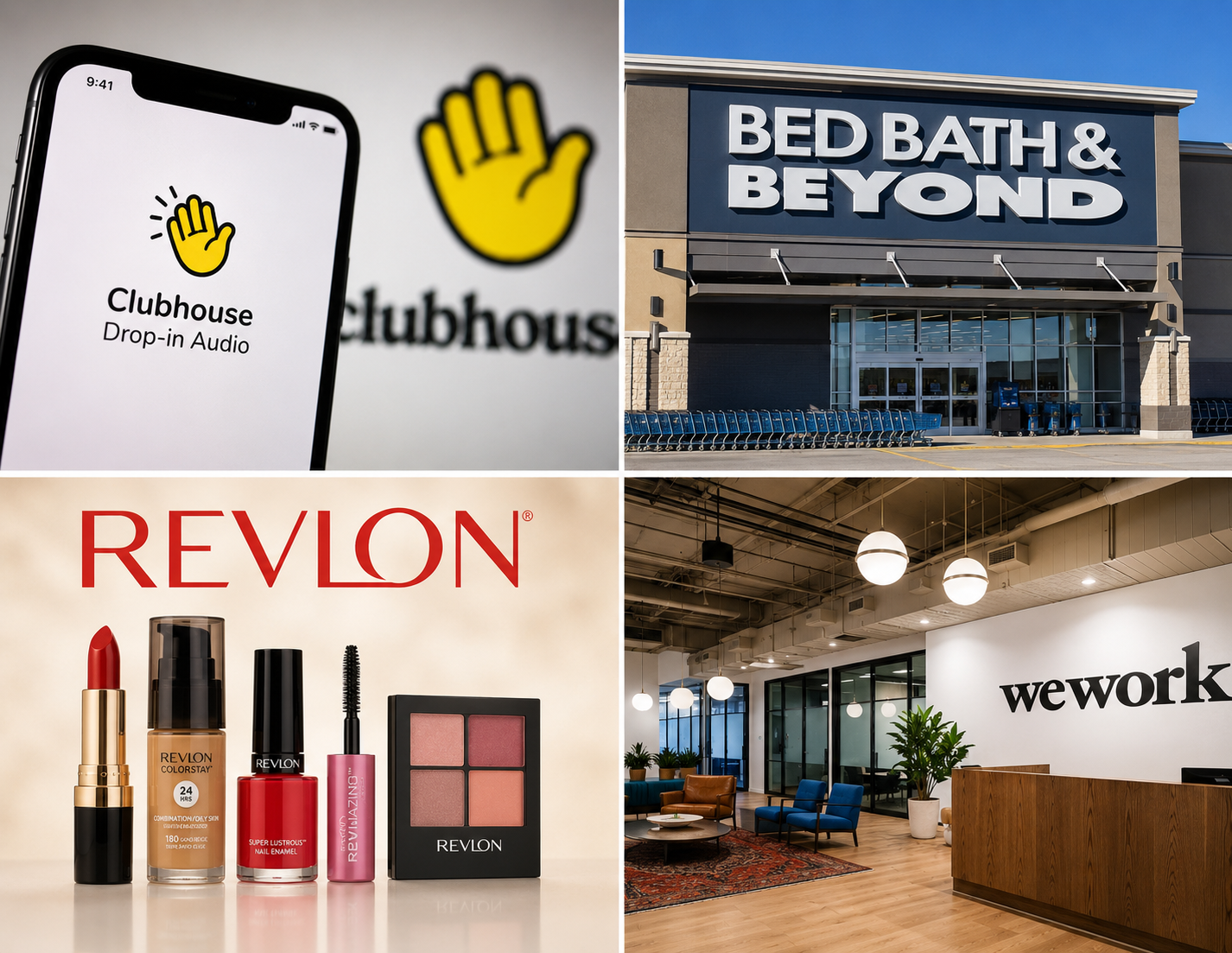
过去四年,我和Poy 在《柠檬变成柠檬水》播客中分析了110多个商业案例。在前两次的总结里,我们分享了成功企业之间的一些非常有意思的共同点,那么在做了那么多期节目之后,我觉得失败的公司其实同样值得研究。
所以今天,我们换一个角度,来看看四个曾经非常成功、后来却遭遇巨大挫折的公司:Clubhouse、Bed Bath & Beyond、Revlon 和 WeWork。
这四家公司几乎没有任何关系。Clubhouse 是曾经红极一时的社交媒体平台;Bed Bath & Beyond 曾经是北美最成功的家居零售商之一;Revlon 是拥有近百年历史的美妆品牌;WeWork 则一度是全球资本市场最炙手可热的创业公司之一。
它们失败的原因当然各不相同,但把这四个案例放在一起以后,我发现了一个很有意思的共同点:它们都曾经非常成功,也都曾经找到过属于自己的正确答案。真正的问题是,当市场、消费者和竞争环境已经悄悄发生变化时,他们似乎没有及时重新问自己:在今天的市场环境里,过去让自己成功的东西,也一定能够继续带领自己走向未来吗?
先说我们播客的第二期 Clubhouse。
如果你还记得2021年,应该会记得 Clubhouse 当时有多火。Elon Musk 等名人的加入、邀请码制造出来的稀缺感,再加上疫情期间大家对于线上社交的巨大需求,让 Clubhouse 几乎在一夜之间成为全球最热门的社交媒体之一。
但是我们当时在播客里讨论 Clubhouse 时,就问了一个非常简单的问题:这么多人来了以后,为什么要留下来?
Clubhouse 当时并不缺流量,它真正缺少的是一个能够让流量持续留下来的商业生态。创作者为什么愿意不断提供高质量内容?他们如何赚钱?用户为什么每天都愿意回来?平台本身又如何赚钱?这些问题如果不能形成一个完整的循环,那么再大的流量,也很难变成真正的用户忠诚。
所以回头看 Clubhouse,我觉得它给企业最大的提醒就是:Attention 不等于 Loyalty。一个产品突然成为热点,很多人下载、讨论、尝试,当然是一件好事。但是用户来过一次,和用户愿意留下十年,是两件完全不同的事情。真正优秀的商业模式,最终必须回答的不是自己能不能把人吸引过来,而是品牌有没有足够的价值让他们留下来。
Bed Bath & Beyond 则是另外一种完全不同的故事。
它的问题并不是没有成功过,恰恰相反,它曾经太成功了。在最辉煌的时候,Bed Bath & Beyond 是美国非常典型的 category killer。巨大的商店、丰富的商品、堆到天花板的库存,再加上几乎人人都熟悉的20%优惠券,形成了一个非常鲜明的消费体验。消费者想买家居用品,第一个想到的地方之一就是 Bed Bath & Beyond。
但是后来消费者变了,零售行业也变了。Amazon 和电商迅速崛起,消费者不再需要开车到一家巨大的商店,在成千上万件商品中寻找自己想要的东西。但 Bed Bath & Beyond 并没有足够快地把资源投入电商和物流,反而进行了多项后来效果并不理想的收购。之后公司又大量发展 private label,删除了很多消费者熟悉的品牌,希望复制 Target 等零售商的成功经验。
问题是,Target 的答案为什么一定是 Bed Bath & Beyond 的答案?这是我觉得这个案例最值得企业管理者思考的地方。我们经常喜欢学习 best practice,也喜欢请曾经成功过的人来复制他们过去的经验。但是一个战略在一家公司取得成功,并不意味着换一个企业、换一个消费者、换一个时间点,它依然会成功。
过去的经验当然是一种资产,但如果我们太相信它,也可能变成一种包袱。
Revlon 的故事更加令人感慨。
1932年创立的 Revlon 曾经是美妆行业真正的创新者。它不仅卖化妆品,也曾经非常懂得如何与女性消费者沟通。早期著名的 “Fire and Ice” 广告大胆挑战当时社会对于女性的传统想象,后来品牌也长期围绕女性独立、魅力和 empowerment 建立自己的形象。
但是到了我们制作 Revlon 那一期节目时,一个非常明显的问题是:大家仍然知道 Revlon,却越来越不知道 Revlon 代表什么。
与此同时,美妆世界已经发生了翻天覆地的变化。Sephora、Ulta 改变了消费者购买美妆产品的方式,Instagram、TikTok 改变了品牌与年轻人沟通的方式,一批新的 DTC 品牌和 celebrity brands 又重新定义了消费者对于美、身份和价值观的理解。而 Revlon 的品牌沟通,却逐渐从过去非常鲜明的 aspiration 和价值观,退回到了产品和功能本身。我们当时在节目里引用过一句我觉得特别准确的话:“The aspiration is gone, it becomes packaged goods.”
我觉得这可能是一个品牌最危险的状态。消费者并没有讨厌你,他们甚至依然认识你,但是他们已经不再在乎你。对于一个历史悠久的品牌来说,brand awareness 从来不等于 brand relevance。过去几十年积累起来的知名度当然非常宝贵,但如果下一代消费者已经找不到与你发生关系的理由,再高的知名度也无法保证未来。
最后再说 WeWork。
如果说 Revlon 的问题是成功了太久,那么 WeWork 的问题可能恰恰相反,它成功得太快了。
Adam Neumann 是一位非常有感染力的创业者。他从来没有把 WeWork 描述成一家出租办公室的房地产公司,而是把它讲成一个重新定义人们如何 work, live and play 的全球社区。这个故事非常有吸引力,它吸引了员工、客户,也吸引了包括 SoftBank 在内的大量资本。
我一直觉得,企业有一个伟大的 vision 并没有错。相反,很多伟大的企业都是从一个看起来不切实际的梦想开始的。但是WeWork 真正的问题是,当这个故事越来越成功、融资越来越容易、估值越来越高的时候,还有没有人愿意停下来问一些最基本、甚至听起来有一点无聊的问题:这个商业模式到底赚不赚钱?这样的扩张速度是否可持续?公司的治理是否健康?创始人的权力有没有边界?
当一个创始人的 vision、个人魅力和过去的成功越来越强大时,一个组织最需要的,反而是有人敢于提出不同意见。如果所有好消息都不断强化原来的判断,而坏消息又越来越难传到决策者耳朵里,那么曾经推动公司高速成长的自信,很容易慢慢变成过度自信。
所以,把 Clubhouse、Bed Bath & Beyond、Revlon 和 WeWork 放在一起,我觉得它们对企业领导者的真正警告,并不是不要犯错误。任何企业都会犯错误,任何管理者也都会做出错误的决定。真正危险的是,一家公司成功以后,慢慢失去了发现自己可能错了的能力。
Clubhouse 曾经相信巨大的 attention 最终可以转化成长期的用户价值;Bed Bath & Beyond 太依赖过去成功的零售逻辑,也试图复制别人已经证明过的答案;Revlon 拥有近百年的品牌知名度,却没有及时回答新一代消费者为什么还需要 Revlon;而 WeWork 在资本、估值和创始人故事不断被市场肯定之后,也越来越难有人停下来质疑这个故事背后的商业逻辑。
有意思的是,这些判断在最开始的时候可能都不是完全错误的。真正的问题在于,市场已经变化了,而企业仍然把过去验证过的答案,当成今天和明天不需要重新验证重新思考的策略了。这也是为什么研究了100多个商业案例以后,我越来越觉得,企业最大的竞争对手,有时候并不是外面的那家公司,而是自己过去的成功经验。
失败通常不会在某一天突然发生。消费者可能只是少来了一点,年轻人开始不再谈论你的品牌,一个新的竞争对手开始获得关注,最优秀的员工开始离开,利润率一点点下降。这些信号最初都很小,小到管理层很容易为它们找到各种合理的解释。
真正优秀的企业,与最终慢慢走向衰退的企业之间最大的区别,也许就在这里:它是否愿意在这些信号还很微弱的时候,就承认过去的答案可能已经不再正确。所以,如果把这四个案例变成一个给企业领导者的问题,我觉得最值得问的并不是:“我们现在的战略是什么?”而是:“我们现在最相信的哪一个答案,有可能已经错了?”
也许我们相信消费者永远需要我们的产品,也许相信几十年建立起来的品牌不会轻易消失,也许相信过去成功的商业模式还可以继续十年,也许相信最大的客户永远不会离开,也许相信自己过去做对了十次,所以第十一次依然会是对的。
但是商业世界最残酷、也最有意思的地方就在于:昨天让你成功的答案,并没有义务让你明天继续成功。所以,也许一家真正优秀的企业最重要的能力,并不是永远知道正确答案,而是在成功的时候,依然愿意不断重新提问。
因为真正危险的,从来不是我们暂时没有答案。而是我们太确信自己已经知道答案,以至于不再提问。
Great Companies Don’t Treat Yesterday’s Success as Tomorrow’s Answer
Over the past four years, Poy and I have analyzed more than 110 business cases on our podcast, Turn Lemons Into Lemonade. In the previous two articles, we shared some interesting patterns we found among successful companies. But after producing so many episodes, I’ve come to believe that companies that fail can be just as valuable to study.
So today, let’s look at four companies that were once enormously successful but later experienced dramatic setbacks: Clubhouse, Bed Bath & Beyond, Revlon, and WeWork.
These four companies could hardly be more different. Clubhouse was once one of the hottest social media platforms in the world. Bed Bath & Beyond was one of North America’s most successful home retailers. Revlon is a beauty brand with nearly a century of history. And WeWork was once one of the most celebrated startups in the global capital markets.
Their problems were obviously very different, but when I put these four cases together, I noticed something interesting. They had all been very successful, and at one point, each had found an answer that worked. The real problem was that as the market, consumers, and competitive environment quietly changed around them, they didn’t seem to stop often enough to ask themselves: Will what made us successful in the past still take us where we need to go tomorrow?
Let’s start with Clubhouse, a company we discussed all the way back in the second episode of our podcast.
If you remember 2021, you probably remember just how quickly Clubhouse exploded. Celebrities such as Elon Musk joined the platform, its invitation-only model created a powerful sense of exclusivity, and the pandemic generated enormous demand for new ways to connect online. Almost overnight, Clubhouse became one of the most talked-about social media platforms in the world.
But when we discussed Clubhouse on our podcast, we asked a very simple question: Once all these people arrive, why should they stay?
Clubhouse didn’t have a traffic problem in 2021. What it lacked was a sustainable ecosystem capable of turning that traffic into long-term engagement. Why would creators continue producing high-quality content? How would they make money? Why would users return every day? And ultimately, how would the platform itself make money? If these elements couldn't form a sustainable cycle, even enormous traffic would struggle to become genuine customer loyalty.
Looking back, perhaps Clubhouse’s biggest lesson for business is this - Attention is not loyalty. Having a product suddenly become a sensation, with millions of people downloading it, talking about it, and trying it, is certainly a great achievement. But getting a customer to visit once and giving that customer a reason to stay for ten years are two completely different things. A truly sustainable business model eventually has to answer not only, “Can we attract people?” but also, “Do we create enough value to make them want to stay?”
Bed Bath & Beyond tells a very different story.
Its problem wasn’t that it had never been successful. Quite the opposite, it had once been extraordinarily successful.
At its peak, Bed Bath & Beyond was a classic American “category killer.” Its enormous stores, huge product assortment, floor-to-ceiling inventory, and famous 20%-off coupons created a very distinctive shopping experience. When consumers needed something for their homes, Bed Bath & Beyond was often one of the first places that came to mind.
But consumers changed, and retail changed with them. Amazon and e-commerce grew rapidly, and customers no longer necessarily needed to drive to a massive store and search through thousands of products to find what they wanted. Yet Bed Bath & Beyond did not move quickly enough to invest in e-commerce and logistics. Instead, it made several acquisitions that ultimately produced disappointing results. Later, the company pushed aggressively into private labels, removing many familiar national brands in an attempt to replicate strategies that had worked for retailers such as Target.
But here is the question: Why should Target’s answer automatically be Bed Bath & Beyond’s answer?
This is one of the most important lessons from the case for business leaders. We love studying best practices, and we love hiring executives who have succeeded elsewhere to replicate what worked for them in the past. But just because a strategy succeeded at one company does not mean it will still succeed with a different company, a different customer, and at a different moment in time.
Past experience is certainly an asset. But if we trust it too much, it can also become baggage.
Revlon’s story is perhaps even more striking.
Founded in 1932, Revlon was once a genuine innovator in the beauty industry. It didn’t simply sell cosmetics; it understood how to communicate with women. Its famous early “Fire and Ice” campaign boldly challenged traditional ideas about femininity, and for decades the brand built its image around independence, glamour, aspiration, and empowerment.
But when we produced our episode on Revlon, one problem stood out very clearly: people still knew Revlon, but increasingly, they no longer knew what Revlon stood for.
Meanwhile, the beauty industry had changed dramatically. Sephora and Ulta transformed how consumers discovered and purchased beauty products. Instagram and TikTok changed how brands communicated with younger generations. A new wave of DTC and celebrity brands began redefining how consumers thought about beauty, identity, and values.
Revlon’s brand communication, however, gradually moved away from the strong aspiration and values that had once made it distinctive and increasingly focused on products and functionality. In our podcast, we quoted one observation that I thought captured the problem perfectly: “The aspiration is gone, it becomes packaged goods.”
I think this may be one of the most dangerous positions for any brand. Consumers don’t hate you. They may still recognize you, but they simply stop caring about you.
For an established brand, brand awareness is never the same thing as brand relevance. Recognition built over decades is enormously valuable, but if the next generation of consumers can no longer find a reason to build a relationship with you, awareness alone cannot guarantee your future.
And finally, there is WeWork.
If Revlon’s problem was that it had been successful for too long, WeWork may have had the opposite problem - it became successful too quickly.
Adam Neumann was an extraordinarily compelling entrepreneur. He never described WeWork as simply a real estate company renting desks and office space. Instead, he presented it as a global community that would redefine how people “work, live and play.” It was an incredibly powerful story. It attracted employees, customers, and enormous amounts of capital, including investment from SoftBank.
I have always believed there is nothing wrong with a company having a great vision. Quite the opposite. Many of the world’s greatest companies began with dreams that initially seemed unrealistic.
But WeWork’s real problem was what happened when the story became increasingly successful, fundraising became easier, and valuations kept rising. Was anyone still willing to stop and ask the most basic, and perhaps least exciting, questions? Does this business model actually make money? Is this pace of expansion sustainable? Is the company governed properly? Should there be limits to the founder’s power?
As a founder’s vision, charisma, and record of success become more powerful, an organization actually needs people who are willing to challenge that founder even more. If every piece of good news reinforces the original assumptions while bad news becomes increasingly difficult to communicate to decision-makers, the confidence that once drove extraordinary growth can gradually turn into overconfidence.
So when I put Clubhouse, Bed Bath & Beyond, Revlon, and WeWork together, I don’t think their most important lesson for business leaders is simply “don’t make mistakes.” Every company makes mistakes, and every leader will eventually make a bad decision. The real danger begins when success causes an organization to gradually lose its ability to recognize that it might be wrong.
Clubhouse appeared to believe that enormous attention could eventually translate into long-term user value. Bed Bath & Beyond relied too heavily on the retail formula that had made it successful in the past while also trying to replicate answers that had worked for other retailers. Revlon had nearly a century of brand recognition but failed to continually answer why a new generation of consumers should still care about Revlon. And as WeWork’s story was repeatedly validated by capital, rising valuations, and investor enthusiasm, it became increasingly difficult for people to challenge the business logic underneath that story.
Final Thoughts
What makes these cases particularly interesting is that these assumptions were not necessarily wrong at the beginning. The real problem was that the market changed, while companies continued treating answers that had once been validated as strategies that no longer needed to be questioned, tested, or reconsidered.
That is why, after studying more than 100 business cases, I increasingly believe that sometimes a company’s greatest competitor isn’t another company; it is its own history of success.
Business failure rarely happens overnight. Customers may simply visit a little less often. Younger consumers may gradually stop talking about your brand. A new competitor may begin attracting attention. Your best employees may start leaving. Margins may decline little by little. At first, these signals are usually small enough that management can find perfectly reasonable explanations for all of them.
Perhaps one of the biggest differences between companies that continue to evolve and companies that eventually decline is whether they are willing to recognize those weak signals early enough, and admit that an answer that worked beautifully in the past may no longer be the right answer today.
So if I were to turn these four cases into one question for business leaders, I wouldn’t ask: “What is our strategy today?” I would ask something much more uncomfortable: “Which of the things we believe most strongly about our business today might no longer be true?”
Maybe we believe customers will always need our product. Maybe we assume that a brand built over decades cannot easily disappear. Maybe we believe the business model that made us successful will continue working for another ten years. Maybe we think our largest customer will never leave. Or perhaps we believe that because we made the right decision ten times before, the eleventh decision will probably be right as well.
But perhaps one of the most unforgiving and fascinating things about business is this: The answer that made you successful yesterday has no obligation to make you successful tomorrow.
That is why I increasingly believe one of the most important capabilities of a truly great company is not always knowing the right answer. It is having the willingness, especially when things are going well, to keep questioning whether its answers are still right.
Because the greatest danger is not that we temporarily don’t know the answer. It is becoming so certain that we already know it that we stop asking the question.